At first, it looked like a shadow.
Just a dark smudge against an endless sheet of sand, barely distinct from the ripples carved by wind and time. Ronald had flown this survey line more than a hundred times. The Libyan desert offered no landmarks, no variation, no mercy. Flat light, flat earth, and a horizon that never seemed to move.
But this shadow didn’t move the way it should have.
As the aircraft advanced, the shape stayed fixed. Ronald banked left, then circled back. The co-pilot leaned closer to the window.
“You seeing that?”
Ronald didn’t answer. He was already dropping altitude.
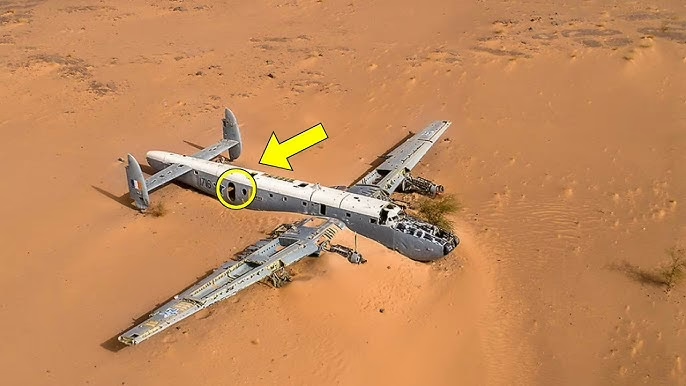
The shape sharpened with every second. Not rock. Not wreckage in the usual sense. Wings. A fuselage. No runway. No road. No reason for an airplane to be here, hundreds of miles inland, where the desert swallowed everything and returned nothing.
What lay beneath them was a bomber.
They circled once more, then set down on the hard pan nearby. When the engine died, the desert rushed in. Silence. Heat. The faint ticking of cooling metal. Their boots sank slightly as they walked, each step carrying the uncomfortable feeling of approaching something that didn’t want to be found.
Up close, there was no doubt.
It was a World War II B-24 Liberator.
The aircraft had belly-landed into the sand, its aluminum skin sandblasted clean by years of wind. The tail still pointed skyward like a warning. Too intact. Too preserved. It looked less like a wreck and more like a relic placed deliberately for the desert to guard.
Records would later confirm its identity: Lady Be Good. A bomber that vanished in April 1943 after a mission over the Mediterranean. At the time, it was assumed lost at sea.
But the sea had never touched it.
Ronald reached the cockpit. The glass was mostly gone, the frame open to the sky. Something inside caught the light. Not bone. Not a weapon.
Paper.
A small stack, shielded from the sun. The ink, astonishingly, was still legible.
It was a diary.
No one spoke as Ronald lifted it free. The words weren’t dramatic. That was what made them unbearable. Short entries. Distances walked. Heat. Thirst. The kind of calm writing a man uses to hold panic at bay.
And then a line that changed everything.
It wasn’t about the crash.
It was about what they carried.
Something that could not be allowed to fall into the wrong hands.
Suddenly the wreck looked different. Not just a dead aircraft, but a container. A burial. The desert wind whispered along the fuselage as if scraping away at a secret too stubborn to disappear.
The co-pilot pointed toward the tail section, where the dunes had piled higher than anywhere else, as though the sand itself was trying to hide one specific place.
They took a small shovel. Nothing official. Nothing that suggested recovery.
The first scrape was easy. The second struck metal. Thicker than aircraft skin. Separate.
Ronald brushed sand away with his bare hands. A strip of stiff khaki emerged. Then a chain. Two dull rectangles swung free.
Dog tags.
They were buried deliberately.
Ronald wiped away the grit and tried to read the stamping. The name meant nothing to him. The unit designation was wrong. The format wasn’t aviation-issued.
This person wasn’t part of the flight crew.
The co-pilot started to speak, then stopped. The diary in Ronald’s hand suddenly felt heavier than paper. It felt like a warning.
They searched the tail section more carefully now. Not like explorers, but like men stepping into something unfinished. Beneath a torn panel, wedged between bent spars, they found a compartment that didn’t appear on any schematic. Improvised. Reinforced. Sealed with wire that didn’t match the rest of the aircraft.
Someone had added it.
Ronald cut the wire.
Inside was a small metal container wrapped in oil-soaked cloth to keep the sand out. No markings. No insignia. Just weight. Purpose.
The diary’s final entries made sense now. They didn’t speak of rescue. They spoke of delay. Of moving away from the coast. Of walking not toward help, but away from something.
One line appeared twice, underlined harder the second time:
Do not let it be found intact.
The crew hadn’t simply survived the crash. They had made a decision.
After the war, investigators reconstructed the rest. The Lady Be Good had overshot its base due to navigational error and fuel exhaustion, landing deep in the Sahara. The crew parachuted out, believing they were near the Mediterranean.
They were wrong.
They walked south. Days turned to weeks. One by one, they died of thirst and heat. Their remains were later found scattered along the route, exactly as the diary described.
But questions remained.
Why had parts of the aircraft been moved?
Why was there an extra set of dog tags from a soldier missing in a completely separate operation?
Why had the aircraft been left deliberately concealed?
Military records hinted at a classified parallel mission. A covert transfer. Equipment not logged, not recoverable. Something small enough to carry. Important enough to hide. Dangerous enough that the crew chose the desert over letting it be captured.
The container was removed and cataloged. Its contents were never publicly disclosed. The files were sealed. The official report closed the case as a navigational failure.
The wreck was left where it lay.
Even decades later, no one seemed eager to disturb what had been buried.
Today, the remains of the Lady Be Good still rest in the Sahara, sun-bleached and silent. Preserved by a desert that keeps secrets better than any vault.
The diary ends without a goodbye.
Just one final sentence, written shakily at the bottom of the page:
We did what we had to.
And if the aircraft had been found earlier, if that compartment had been opened during the war, the desert wouldn’t have been the only thing swallowing the truth.